Cuneiform collection
![[Shu-Sin cuneiform tablet]](https://library.sydney.edu.au/browse/special-collections/cuneiform-collection/_jcr_content/root/container/container/image.coreimg.jpeg/1762488386894/cuneiform-tablet.jpeg)
The oldest items in Rare Books and Special Collections are Sumerian cuneiform inscriptions.
The cuneiform tablet (2036 BC) is from the reign of Shu-Sin, King of Ur. It's inscribed with seven lines of Sumerian cuneiform and deals with the exchange of two sheep by an official named Urmes to the scribe named Dugg'a.
I addition to the owner’s name, this seal was engraved with a scene showing the standing figure of Dugg'a being presented by a goddess to a seated deity.
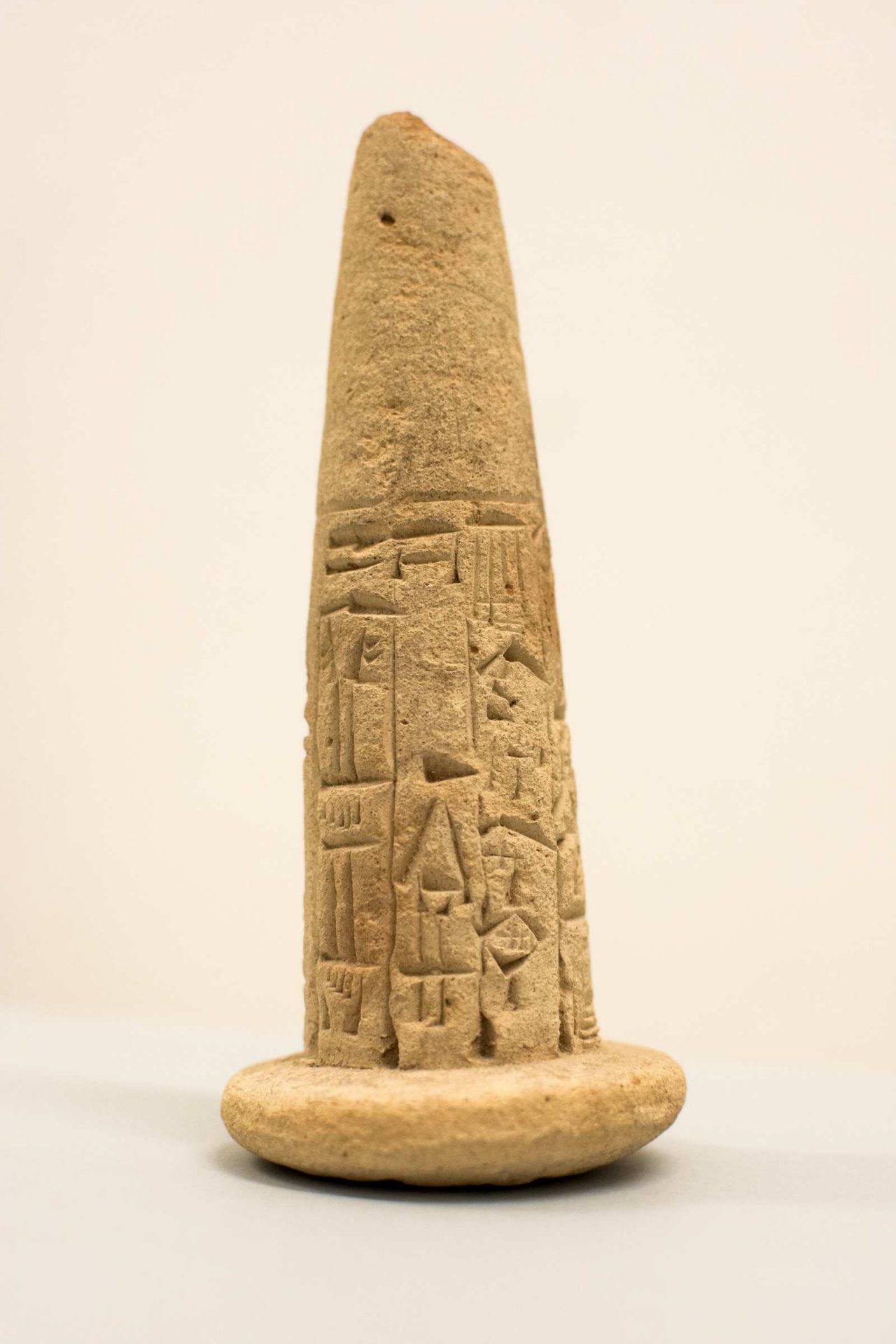
The cylindrical cuneiform cone (2350 BC) is a Sumerian calendar inscribed to record the building of the temple E-Ninnû, shrine of the patron god Ningirsu.
Inscription translation: “[To the god] Ningirsu, the Mighty Warrior, Lord of the Exalted Temple, Gudea, Prince Pontiff [of] Shirpula [i.e. Lagash], its foundation he built. The Temple of E-Ninnû to Ningirsu he dedicated and built.”
Call number - cuneiform cone: Add.Ms. 328a
Call number - cuneiform tablet: Add.Ms. 328
Access these items
Rare Books and Special Collections (RBSC) can be accessed by staff, students and academics (using existing University credentials), as well as the general public (by registering for a free RBSC community membership).
These items can be located in the Library catalogue. Make a request to view an item, under "more options" (at least 2 business days in advance). Then visit the Rare Books and Special Collections Reading Room during opening hours to view.
Teach with this item
The Library's extensive Rare Books and Special Collections are available to support research and education, through activities including:
Academic-led classes
Library-led classes / Object Based Learning (OBL)
using digitised content
Contact
Please email enquiries to cultural.collections@usyd.libanswers.com