Printer in residence

About the residency
We're inviting you to engage with our collections and community through the Piscator Press, and to bring the Library's spaces to life through your inspiring project.
The Printer in Residence program is designed to:
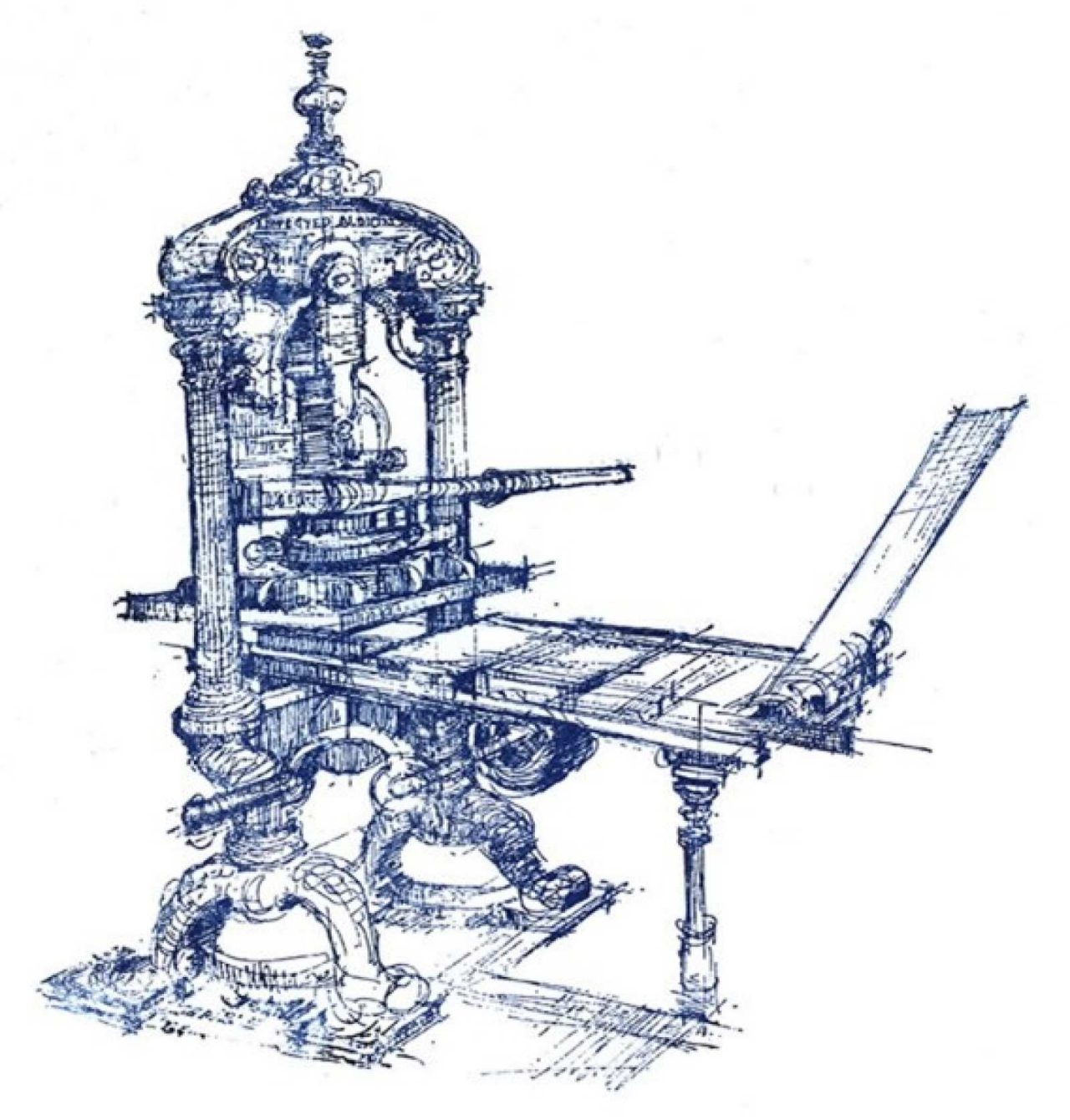
- increase awareness of the Library’s Albion letterpress printer, affectionately known as the Piscator Press
- encourage ongoing enthusiasm for book arts within the University
- foster a creative dialogue between print and digital processes, experimentation and engagement with the Library community.
The successful resident will be required to produce a publication or artwork for the Library’s Rare Books and Special Collections as a contribution to the growing archive of artist’s books available in the Library.
If you would like to discuss your project before submission, email: cultural.collections@usyd.libanswers.com
About the workshop
The printing workshop is located on level 1 of Fisher Library on the Camperdown Campus.
The workshop has a direct affiliation with the University Library’s Rare Books and Special Collections, and residents are encouraged to utilise spaces throughout Fisher Library.
Technical abilities and available equipment
Candidates must:
- demonstrate knowledge and skill in using an Albion letterpress (or similar)
- use the equipment and type available in the Press (see Inventory for indicative images of the space and equipment) as well as any materials they may supply.
The library cannot offer technical support in using the available equipment. We are working towards an environmentally friendly print workshop, so only soy or water-based inks and non-toxic cleaning agents are to be used.
Download Piscator Press workshop and equipment inventory (pdf, 1367KB)
What the residency provides
- A gross payment of $10,000 to be paid in three instalments over the 8-week residency period.
- Access to the Rare Books and Special Collections of the University Library as a community user.
- Research support from relevant library staff.
- Use of the Piscator Press workshop.
- Standard qualities and quantities of ink and paper.
Terms of the residency
- The residency must be arranged for 8 weeks during the University of Sydney Semester 2, 2026, between August–October.
- The residency is acquisitive, so a copy of the publication/creative work will be supplied to Rare Books and Special Collections. The resident also grants the University Library a non-exclusive license to reproduce the work for the purposes of teaching and research activity and promotion of the Residency.
- An offer from the University to take up the residency is dependent on agreement of the residency structure and preferred dates.
- The $10,000 residency payment is to cover all costs associated with the residency period, including any additional materials required to complete the work (aside from provided standard ink and paper stock) and payment to any collaborators.
- The University cannot provide any travel or accommodation support for the artist. Any travel or accommodation requirements are to be arranged by the artist at their own expense.
- The Printer in Residence will be asked to participate in a variety of outreach and engagement activities. The proposed program will be arranged in agreement with the Library and include a minimum:
- two Open Studios, proposed in week 3 and week 6 of the residency
- a public talk and exhibition (including work in progress) at the culmination of the residency
- a workshop with Sydney College of the Arts print media students
- Any external collaborators or visitors to the workshop must be arranged in agreement with the library.
- The resident will be responsible for keeping facilities and equipment in the Piscator Press workshop clean and tidy, and must adhere to University Work Health and Safety guidelines.
Important note
Visa Sponsorship is not available for this position – applicants must be an Australian Citizen or have Permanent Residency or existing work rights relevant to the term of the position. Sponsorship is position-specific and is not transferrable between roles.
The Library would like to acknowledge the ongoing support of Friends of the Library and The Penrith Print Museum
Previous Printers in Residence


2024: Keg de Souza
Keg de Souza, an interdisciplinary artist of Goan ancestry creates social and spatial environments through methods such as handmade books, zines, sculptures, videos, workshops, and tours. Her practice reflects on concepts of place, displacement, and marginalised voices, exploring themes like colonialism, gentrification, food politics, and radical pedagogy. She has exhibited widely across Australia and internationally, including projects for major institutions and biennales in Edinburgh, London, Sydney, Vancouver, Auckland, and Jakarta.
Keg’s project Eucalyptus through Empire (2024) continues her collaboration with Awabakal Elders and brothers Uncle Doug Archibald and Uncle Norm Archibald and her research referencing early Australian botanist's Edward Maidan's work, A critical revision of the genus Eucalyptus (1903-1933) held in Rare Books and Special Collections. Keg's concertina artist books recreate the Uncles' shared stories of Eucalyptus trees marking sites of significance - a two-trunked tree marking a camp location and a scar tree. These works sit alongside printed bark and leaves that Keg had permission to take from Country. Copies were exhibited at MAC Yapang in December 2024 and are now held in Rare Books and Special Collections.


2023: Mickie Quick
Mickie Quick (aka Michael Hender) is known for combining street art, printmaking and activist interventions through zines, installations, and collaborative art networks. His practice spans guerrilla urban pranks in Perth during the 1990s to socially engaged projects and letterpress printing as a founding member of Bad Press, an artist-run printing collective in Sydney operating since 2004. Mickie is also the Publications Manager of Honi Soit, the Students' Representative Council's weekly newspaper at the University of Sydney.
Mickie’s project, Honi Soit (2023), draws on Rare Books and Special Collections’ archive of the student newspaper founded in 1929 and still published today. Mickie reinterprets the paper’s progressive political themes, text, and imagery in a series of prints to both reflect and expand on its history and that of letterpress printing. This included collaborating with the 2023 editorial team, and engagement with former contributor Rowan Cahill (1960s), culminating in Still in Print: a front cover of Honi Soit printed on the Piscator Press and a back cover featuring a photograph of the original locked-up type used to produce the print.


2020-2022: Caren Florance
Caren Florance, an innovative printer, artist and researcher works with letterpress, artist books, and text-based printmaking under the imprint Ampersand Duck. Her practice explores materiality, collaboration, and the intersection of analogue and digital processes. She exhibits nationally, teaches across universities, and her works are held in major public and private collections.
Caren combined two projects starting with ALTSHIFT-PRINT looking at alternative publications, poetry and campus culture before shifting her focus to explore themes of change and survival through transformation: C:/Ovid: Changing to Survive (2020-2022) with a play on Ovid's poem Metamorphoses during the Covid. Caren's daily experiments responding to the times engaged library users and became a popular feature of her residence including participants printing their own facial masks with: Mask appreciated, Wearing one anyway and Least Worst Option. Due to time constrictions, Caren's limited edition artist book: C:/Ovid: Changing to Survive was printed using Risography (a combination of photography and screenprint, printed from digital files).


2019: Barbara Campbell
Barbara Campbell, a printmaker, performer, and former librarian has taught in university art schools across Australia, Hong Kong, London, and the USA, working with students at all levels of experience. She prepared for her residence by training at the Penrith Museum of Printing.
Barbara's project, A Bird is in the Library (2019) extended her PhD research on bird–human interactions into the realm of letterpress. Inspired by the indigenous author, Jakelin Troy's glossary in The Sydney language, Barbara produced a series of prints to lead library users on a bird journey through the library. The fainter the print, the more endangered the native bird. Her final output Bird Voices, is a small hand-made book reciting the calls of various birds inspired by the classifications found in Peter Slater’s A Field Guide to Australian Birds.


2018: Wendy Murray
Wendy Murray, a visual artist and arts educator working between Sydney, Australia, and Nashville, USA, was our inaugural Printer in Residence in 2018. Influenced by street art and graffiti, Wendy's practice combines poster-making, drawing, and public art to address social and and political issues affecting urban environments.
Wendy Murray’s project Sydney – We Need to Talk! (2018) in collaboration with the Sydney Urban Crew, a collective of researchers at the University of Sydney, resulted in an artist book exploring the politics of urbanisation, transforming seminar discussions into print through a dynamic blend of traditional letterpress and digital processes. Wendy invited participants to actively engage with her and her work in open studios and through large poster billboard activations. Her work referenced former University Librarian Harrison Bryan’s 1963 article “Private Press in Fisher” and its guiding principle “to print well”, and the Piscator Press's early link to the Sydney School of Architecture, Design and Planning through Allan Allmen Gamble's 1964's sketch.
Related information
Contact
For further information about the residency or to discuss your application, email Rare Books & Special Collections